
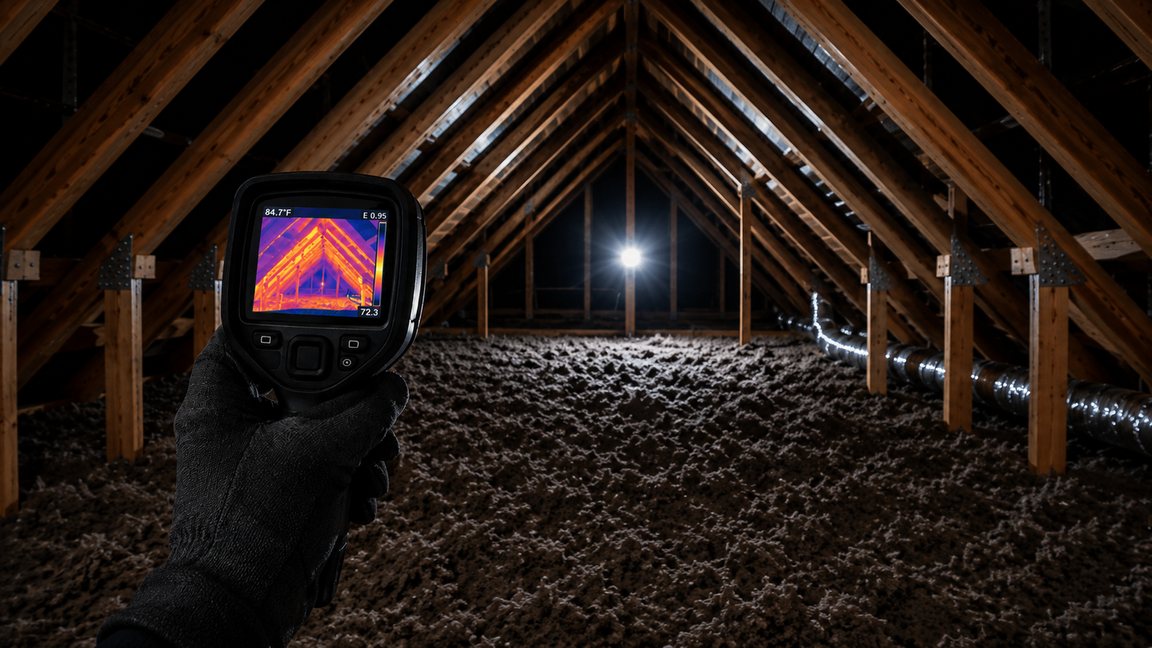
Thermal Imaging InspectionRead the patterns the surface gives away.
Moisture, missing insulation, and overheating circuits all leave thermal fingerprints before they leave visible ones. Infrared scanning reads them — and moisture-meter confirmation keeps the findings honest.
- Annotated IR images — paired with visible-light photos
- Moisture confirmation — meter readings on anomalies
- Electrical screening — hot spots flagged for specialists
- Integrated — one report, thermal included
From anomaly to answer.
Describe the question
A stain, a warm room, a mystery bill — thermal targets it.
Infrared scan
Surface temperature patterns made visible, room by room.
Instrument confirmation
Moisture meters verify every meaningful anomaly.
Findings within 24 hours
IR + visible photo pairs with recommended follow-ups.
Put the camera on it this week.
Where infrared earns its findings.
Screening-level scanning, confirmed with instruments — here's where it changes what a report can catch.
Moisture intrusion screening
Roof leaks, window and door flashing failures, and plumbing-wall seepage — thermal patterns confirmed by moisture meter before they reach your report.
Insulation & energy loss
Voids, settled batts, and thermal bypasses mapped across ceilings and walls — why one room never cools in a Florida August.
Electrical hot-spot screening
Panels, breakers, and connections scanned under load for temperature anomalies that flag failing components for licensed-electrician evaluation.
HVAC & duct performance
Supply temperatures, duct leakage into attics, and register deltas — performance documented, not guessed from a thermostat reading.
Post-repair verification
After a roof repair or plumbing fix: a re-scan documenting that the thermal signature is gone — evidence the repair actually worked.
Thermal evidence with its chain of custody.
Every reported thermal finding arrives as a pair — the infrared image and the visible-light photo of the same location — annotated with what the pattern indicates, what instrument reading confirmed it, and what follow-up is recommended. Screening-level findings labeled as exactly that: honest scope is what makes the findings usable.
Every thermal scan
- Annotated IR images — paired with visible-light photos
- Moisture confirmation — meter readings on anomalies
- Electrical screening — hot spots flagged for specialists
- Integrated — one report, thermal included
- IR + visible pairs — every finding, both spectrums
- Meter confirmation — anomalies verified, not assumed
- CMI interpretation — trained thermography reading
- 24-hour report — integrated findings

Brian Walker, CMI™
Every Lunar inspection is performed and signed by Brian Walker — an InterNACHI Certified Master Inspector and My Safe Florida Home participating inspector whose background includes contracted housing inspections supporting U.S. Army housing programs, with 20+ years of building, remodeling, and field experience behind the credential.
One inspector, one standard: contractor-grade evaluation, insurer-grade documentation, and a direct line to the person who actually walked your property.
Lunar Home & Commercial Inspections
Thermal questions, answered.
Surface temperature differences. Wet materials, missing insulation, air leakage, and overheating electrical components all change how a surface holds temperature — and an infrared camera makes those patterns visible. The camera doesn't see inside walls; it sees the thermal story the wall tells.
It's screening-level evidence, and we're careful about that. A thermal anomaly is an indicator that directs further evaluation — moisture-meter confirmation, direct access, or a specialist — not a standalone verdict. Our reports state thermal findings with that discipline: what the camera showed, what confirmed it, what warrants follow-up.
Suspected moisture intrusion (roofs, windows, plumbing walls), insulation-gap and energy complaints, radiant-system leaks, post-repair verification, and electrical hot-spot screening at panels and connections. It adds a diagnostic layer to nearly any residential or commercial inspection.
Often, yes — evaporative cooling makes damp materials read differently before staining appears. But conditions matter (temperature differentials, recent rain, sun load), and a dry surface at scan time is a finding about that moment, not a warranty against future leaks. That's why anomalies get moisture-meter confirmation.
Annotated thermal images paired with visible-light photos of the same locations, with findings, confirmations, and recommended follow-ups integrated into the 24-hour inspection report.
The standard behind every visit.
Certified Master Inspector
The profession's highest credential. Reports signed by a CMI carry weight with agents, lenders, and insurance carriers.
Federal-contract discipline
Brian performed contracted housing inspections supporting U.S. Army housing programs. Your property gets the same checklist rigor — nothing skipped, everything documented.
24-hour reports
Photo-documented digital reports, most delivered within 24 hours, so inspection contingencies and carrier deadlines stay on track.
Technology on every visit
Thermal imaging and instrument diagnostics deployed whenever conditions call for them — documented in the same report.
Northeast Florida native
Coastal wind exposure, mid-century Jacksonville wiring, St. Johns new builds — we inspect what this region actually has.
Support after the report
Complimentary repair re-inspection verification and plain-English answers — the report is the start of the relationship, not the end.